
Six dimensions for weighing an agent, fees heaviest
How to compare agents without inventing a scoreboard: six dimensions, single facts with dates where facts exist, and a written checklist for the parts no table can hold. No desk gets a medal here; situations get a desk.
Service, speed, safety, trust, routes, fees
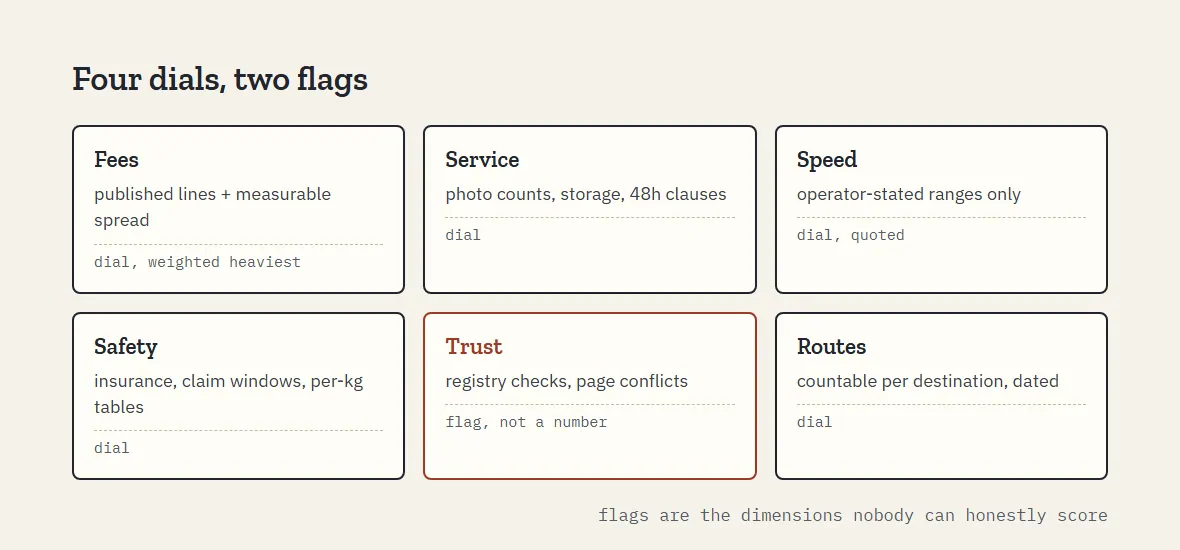
Every agent pitch collapses into six questions. Four of them have published, dateable answers; two of them only have signals. Keeping the two kinds apart is the whole method of this site.
| Dimension | What is actually checkable | Where the evidence lives |
|---|---|---|
| Fees (weightiest) | Service fee lines, top-up surcharges, storage meters, exchange-rate spread; all published or measurable on a date. | Costs page, every figure dated. |
| Service | What the desk does on its own account: QC photo counts, free storage days, response-time clauses (48 hours appears twice in the ledger). | Collected on the Agent profiles page. |
| Speed | Only the operator’s own stated ranges are quotable; transit promises belong to carriers, not desks. | Shipping page, quoted with dates. |
| Safety | Insurance products, claim windows, per-kg compensation tables; also what the desk disclaims without insurance. | Undo windows, dispatched stage. |
| Trust | A signal, not a number: whether the operating entity is findable in a public register, whether terms conflict page to page. | Catalogued under Risk signals with worked cases. |
| Route coverage | Countable per destination on a date: 23 routes to the US at one desk, 37 at another, 16 in a third’s calculator, all 2026-10-10. | Counted on the Shipping page with the query shown. |
Dimensions with no public, reproducible data source never get a number on this site; that is the line between comparison and fiction.
The fee dimension, worked once
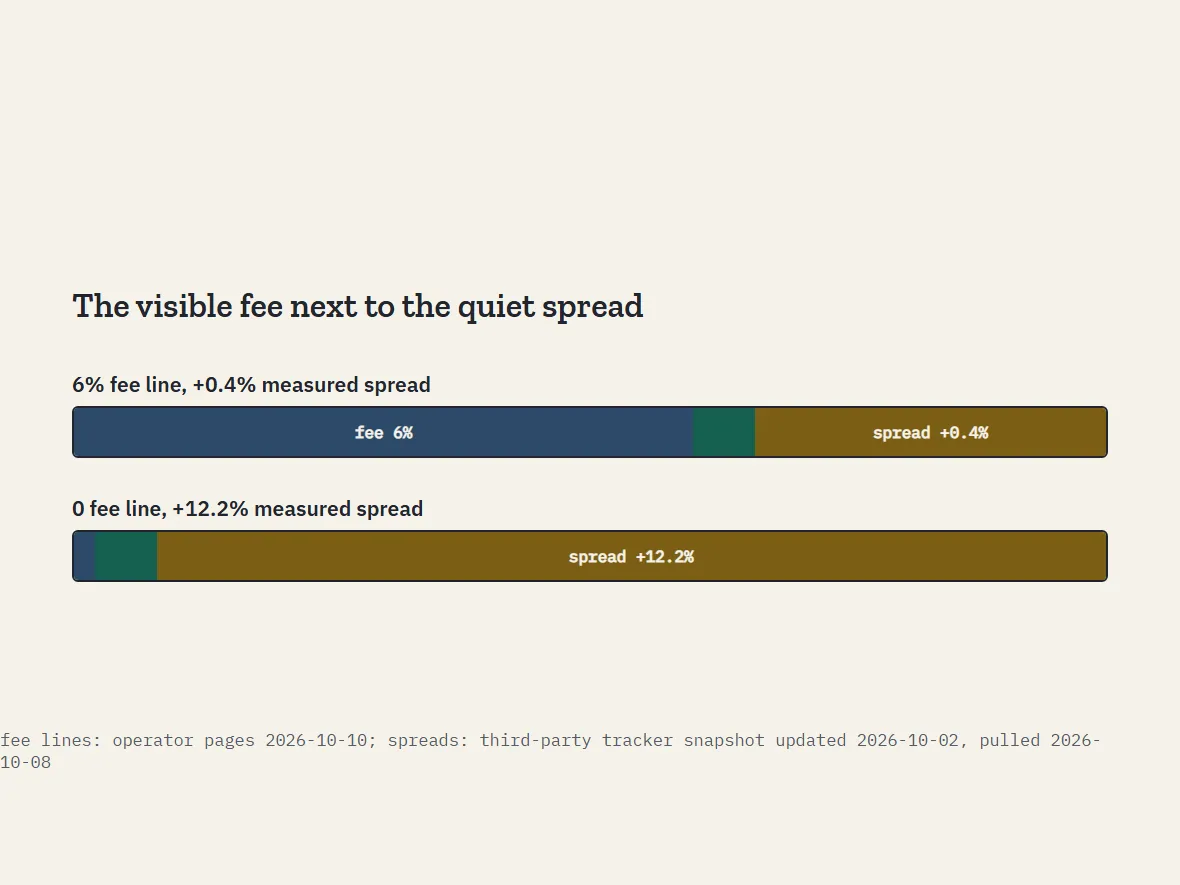
Fees deserve the worked example because the headline number misleads. Four of the six ledger desks publish a zero service fee, LoongBuy among them; one (CSSBuy) publishes 6% with VIP tiers at 5, 4 and 3% (help page, read 2026-10-10). Zero-fee desks are not free: the spread between their checkout exchange rate and the mid-market rate ran from +0.4% to +12.2% across the six in a third-party snapshot updated 2026-10-02.
So a 6% desk with a +0.4% spread can underprice a zero-fee desk with a +12.2% spread on a small haul, and the reverse on a heavy one. The arithmetic is on the costs page; the lesson is that fee lines only mean something summed over your actual basket.
The checklist before the first payment
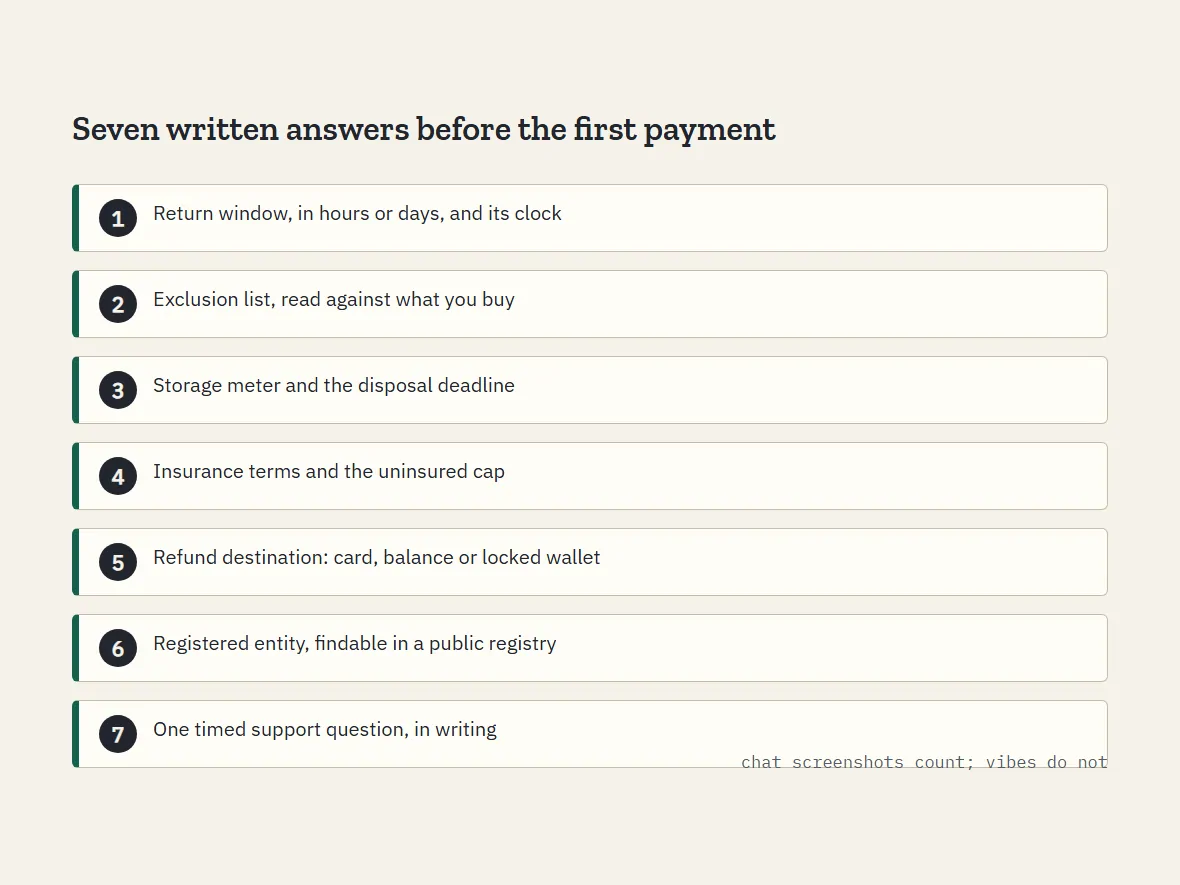
The six dimensions sort desks; this list protects you from any single one of them. Before the first order on a new desk, find written answers to all seven:
- The no-reason return window, in hours or days, and which status starts the clock.
- The exclusion list for that window, read against what you actually buy.
- The storage meter: free days, the per-day or per-month fee after, and the disposal deadline.
- The insurance terms for your usual route, including the uninsured compensation cap.
- The refund destination: original payment method, wallet, or a wallet that cannot withdraw.
- The operating entity’s registered name and number, and that it appears in a public registry.
- One deliberate support question in writing, timed, before money is involved.
Each line maps to a ledger field on the profiles page, so for the six desks here the reading is already done; the list is for the seventh desk, the one some influencer ships you toward next month.
Compare the same basket, at the same point in the order
Build one comparison request before collecting prices: seller links and exact variants, quantity, destination and the relevant goods type. Use the same assumed parcel measurements for preliminary estimates and replace them with packed measurements when available. Otherwise two totals may describe different services.
For each agent, record the goods and domestic-delivery payment, service and payment charges, balance credited, inspection options, storage terms and international quote. Ask which costs are already included so that you do not add a processing fee twice or omit it entirely.
If one option lacks a route for the actual contents, keep that gap visible rather than assigning it the cheapest unrestricted quote. If a policy is unclear, ask the same specific question at both services. The useful result is a fit for this purchase, with unresolved conditions recorded, rather than a universal winner.