
The cost anatomy: fee lines, spreads and meters
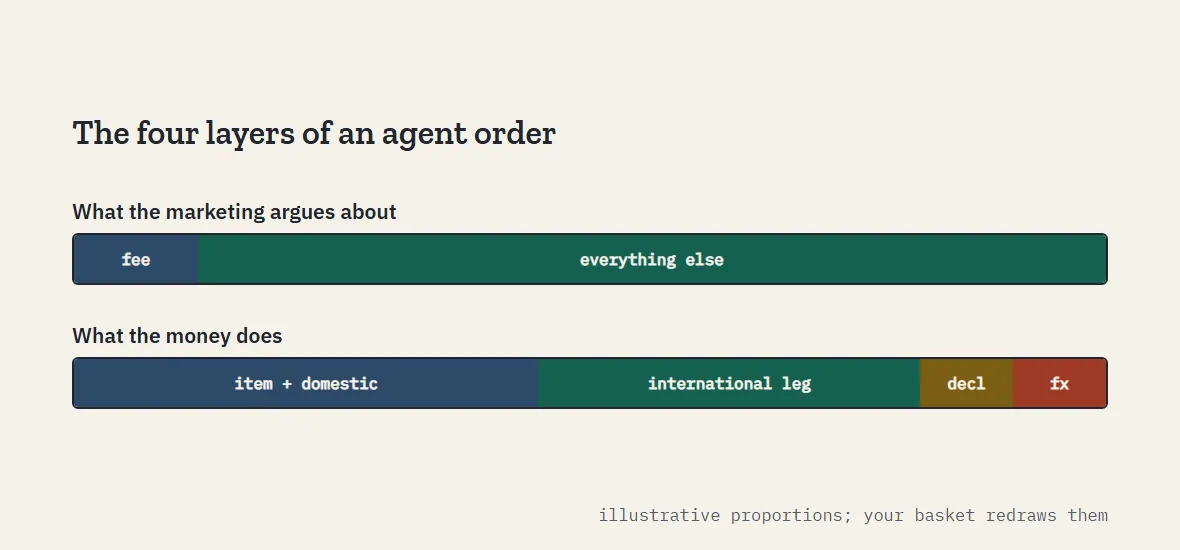
What you actually pay through an agent is four layers: the item, the desk’s fee line, the exchange-rate spread, and the meters that tick while you wait. This page is the cost breakdown with every number dated, including the surcharges that only appear at the top-up screen.
The service fee line, desk by desk
The headline layer first. Four ledger desks publish a zero service fee and recover margin elsewhere; the fee-charging exception is explicit about its maths:
| Desk | Published fee line | Read |
|---|---|---|
| LoongBuy | 0 service fee by the operator’s own wording; total cost is product cost plus international shipping plus customs declaration fee, with value-added services optional | 2026-10-10 |
| Kakobuy | no agent handling fee; you pay item cost, domestic freight, international shipping and a customs declaration charge of generally RMB 8 per parcel, plus optional add-ons | 2026-10-10 |
| Oopbuy | no agent service fee; product cost, domestic freight, international shipping and customs clearance fee only, with value-added services as optional extras | 2026-10-10 |
| CSSBuy | 6% of product price plus China freight for ordinary members; VIP tiers pay 5/4/3% at cumulative spend of 5,000 / 50,000 / 200,000 yuan | 2026-10-10 |
| Superbuy | no purchasing fee line on Taobao, Tmall, JD.com or 1688; customs declaration generally RMB 8 per parcel | 2026-10-10 |
| Lovegobuy | no separate agent fee listed; total is item cost plus international shipping plus customs charges, with declaration generally RMB 8 per parcel | 2026-10-10 |
A customs declaration charge of generally RMB 8 per parcel recurs across several desks’ pages; it is a pass-through, not a margin line.
The spread: where zero-fee desks earn
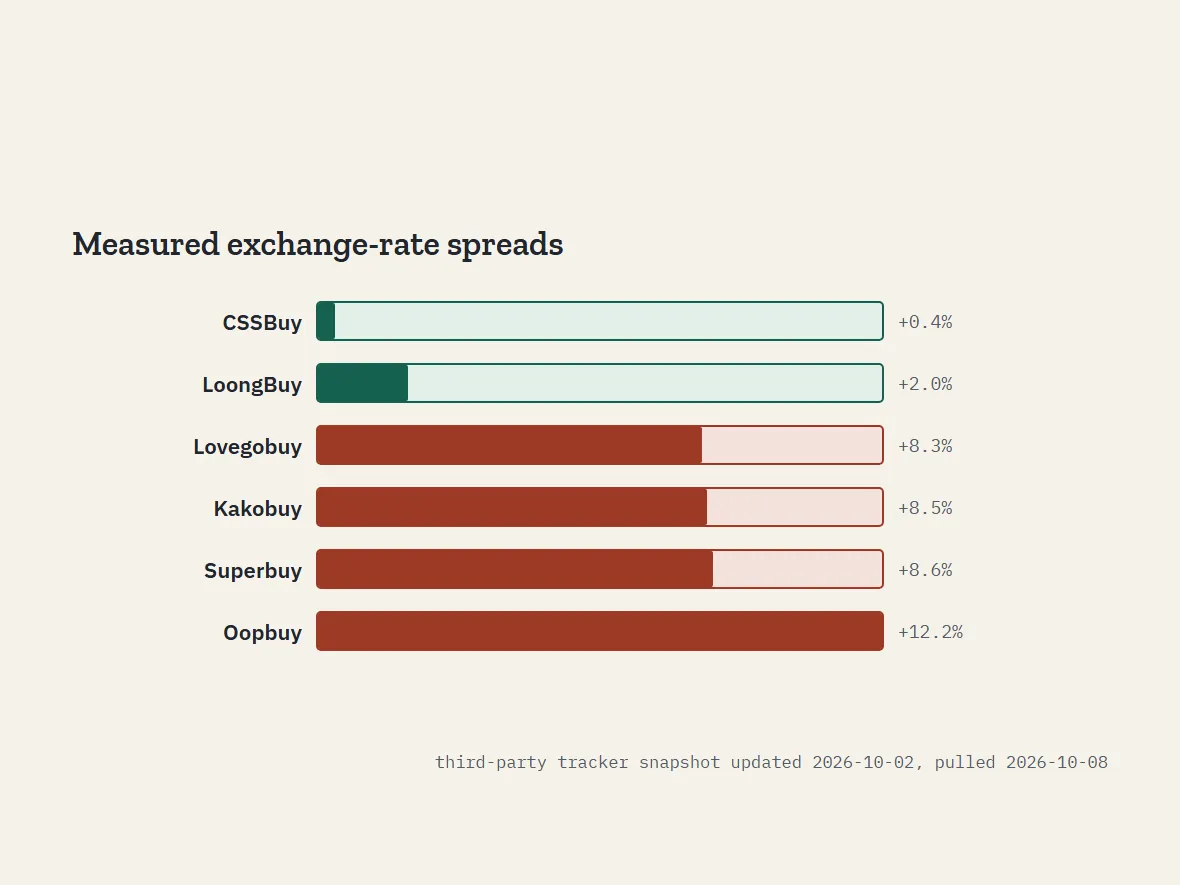
Every desk sells you yuan at its own exchange rate. The gap between that rate and mid-market is the quietest line in the stack, and the widest variable in the ledger: measured spreads ran +0.4% (CSSBuy), +2.0% (LoongBuy), +8.3% (Lovegobuy), +8.5% (Kakobuy), +8.6% (Superbuy) and +12.2% (Oopbuy) in a third-party snapshot updated 2026-10-02, pulled 2026-10-08.
Spreads move, so treat those readings as a method, no more: on the day you pay, divide the desk’s checkout total by the mid-market rate and see what percentage appears. Sixty seconds, and it reprices a zero-fee desk honestly.
The currency conversion itself is unavoidable; paying the spread blind is the part you can decline.
The meters: free days, then a tap left running
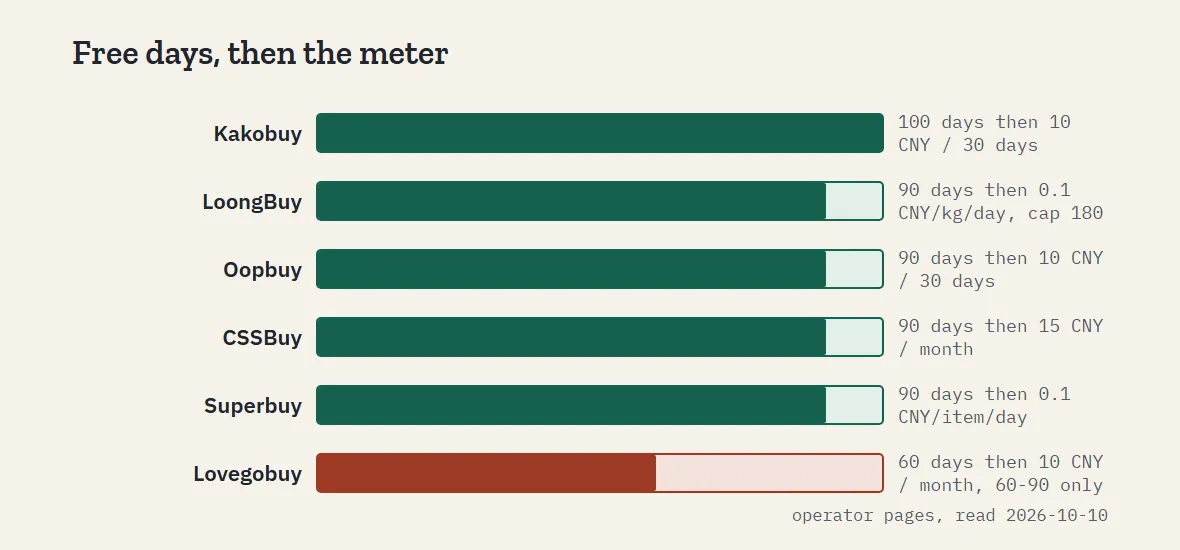
Storage is free until it is not, and the desks meter it differently enough to change behaviour:
| Desk | Free storage and what follows | Read |
|---|---|---|
| LoongBuy | 90 free days from Warehoused status; after that the meter runs at RMB 0.1 per kg daily (floor 0.1 per item), hard stop at 180 days, after which the item is treated as abandoned | 2026-10-10 |
| Kakobuy | 100 free days from in-storage status with a reminder mail on day 90; abnormal parcels only get 60 days counted from Signed for; extensions cost 10 yuan per OG order per 30 days, and a 30-day cooling-off period follows expiry | 2026-10-10 |
| Oopbuy | 90 free days from received status (30 for abnormal parcels); extension costs 10 CNY per 30 days, and one page caps the whole stay at 120 days while another allows 6 months, a live conflict worth asking support about | 2026-10-10 |
| CSSBuy | 90 free days for orders (cut from 180 effective 2024-06-01), 30 for parcels; extensions 15 RMB per ID per month for orders, 30 RMB per parcel; a live popup dated 2026-10-09 announces parcels expired before 2026-01-01 will be cleared from 2026-11-01 | 2026-10-10 |
| Superbuy | 90 free days, then CNY 0.1 per item (DI) per day through day 180; past 180 days with no shipping order the goods are disposed of; an Extended Storage service costs CNY 10 per month, max 6 months per purchase | 2026-10-10 |
| Lovegobuy | 60 free days from stored status, the shortest among the six; then Extend Storage at 10 RMB per product ID per month, only bookable between days 60 and 90, total stay capped at 6 months | 2026-10-10 |
Clocks start at each desk’s own warehouse status; disposal deadlines are the numbers to diary, not the fees.
Top-up surcharges and the payment rails
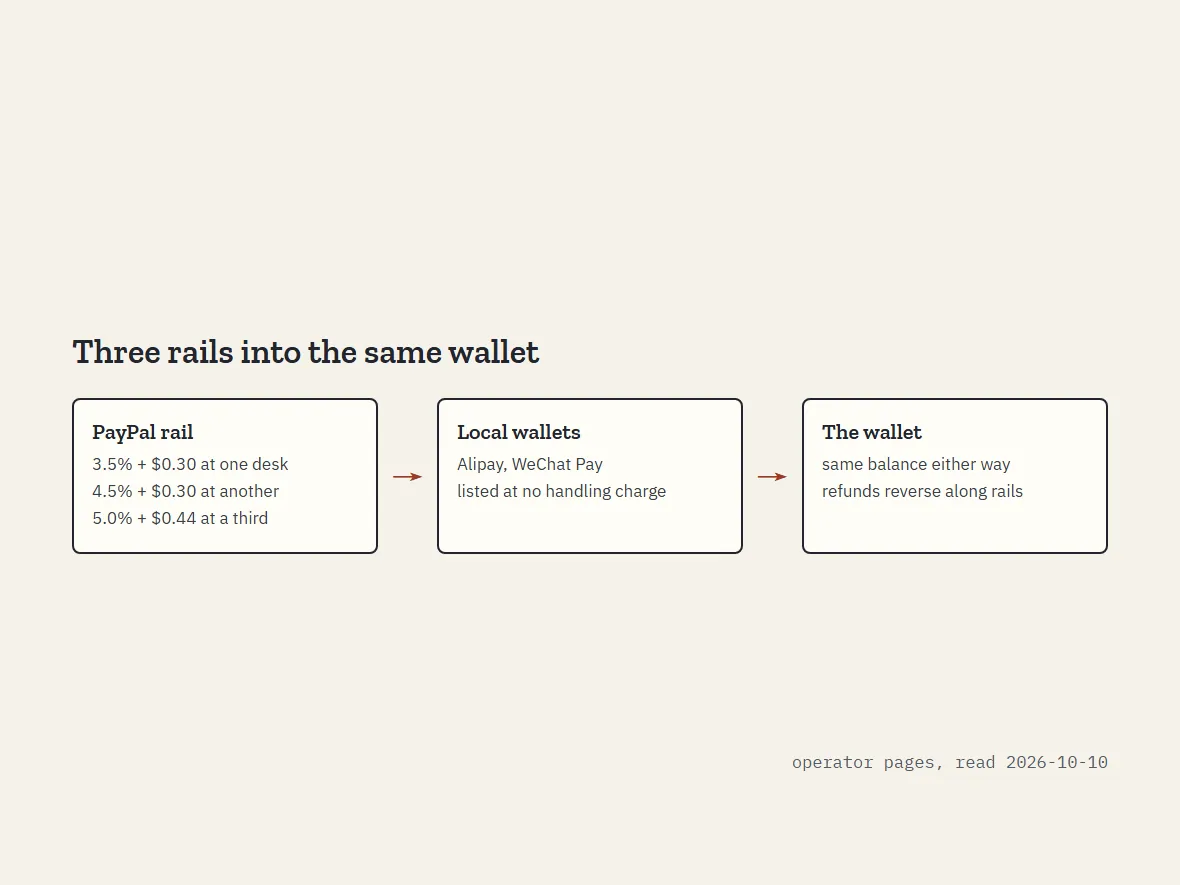
The last layer appears before any shopping: moving money onto a desk costs money on some rails and nothing on others. Published examples: Kakobuy prices PayPal top-ups at 3.5% plus $0.30 while listing Alipay and WeChat Pay at no handling charge; Oopbuy prices PayPal at 4.5% plus $0.30; Lovegobuy at 5.0% plus $0.44 (operator pages, all read 2026-10-10).
The pattern to exploit: card-to-wallet rails carry the surcharges, local-wallet rails often do not, and a desk’s cheapest rail is usually documented only in its help centre, never at the checkout.
Refunds reverse along these same rails with their own rules; the landing zones are covered on the undo page.